
What Is the Science Behind the Approach That Helps Children Become Stronger Readers and Writers?
Picture a child who reads the same paragraph three times and still can't tell you what it said. Or a child who knows what they want to write but can't get the words onto the page.
Most families assume the answer is more practice. But practice without the right conditions doesn't produce understanding. It produces repetition.
What changes everything is understanding how your child's brain actually builds knowledge, and designing instruction around that.
Learning deepens when it builds on what your child already knows.
This is one of the most consistently supported findings in cognitive science. When your child encounters something new, the brain looks for an existing mental framework to attach it to. When that connection exists, understanding forms more quickly and stays longer. When it doesn't, the information sits without roots.
This is why the content your child learns through matters as much as the strategy being used. When new learning connects to your child's own experiences, their community, and the way they already make sense of the world, the brain processes it more deeply. That's not a philosophy. That's how memory and encoding actually work.
Every lesson here is built around content that connects to who your child is and what they already know.
Reading and writing both begin with what the brain can picture.
Strong readers build a mental image as they read. Strong writers picture what they want to say before they find the words for it. These are not natural talents some children are born with. They are specific cognitive skills that can be taught directly.
When a child reads without building any mental picture, comprehension stays shallow. When a child writes without any internal image to work from, the words don't come, or they come without organization.
One of the foundational skills built in every session here is visualization: teaching your child to use what they see in their mind to take in what they read and get their ideas onto the page.
Real learning happens when your child learns how to think, not just what to do.
Confidence grows when progress feels possible and visible.
Confidence isn't something that appears before the work begins. It's the result of a child experiencing their own competence, one small step at a time.
When skills are broken into clear, sequenced steps, your child sees progress early and often. That visibility matters. A child who can look back and say "I couldn't do that last week and now I can" is building something more durable than a grade. They're building a picture of themselves as someone who can grow.
Practice matters most when it has a clear purpose.
More work does not mean more learning. Research on deliberate practice is consistent on this point: the quality and intentionality of practice matters far more than the quantity.
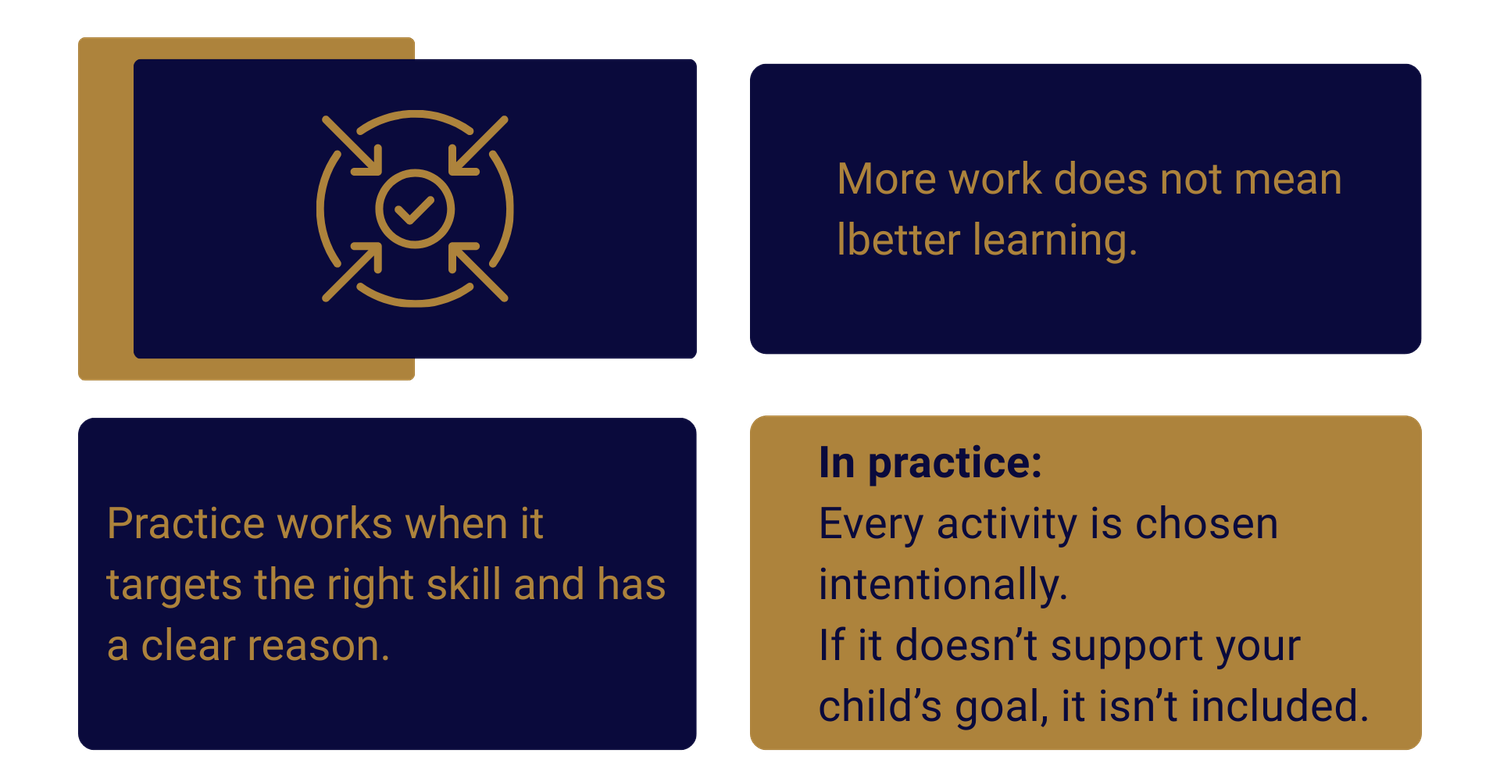
When practice targets the right skill at the right level with a clear reason behind it, the brain encodes the skill more effectively. When practice is generic or disconnected from what your child actually needs, it produces effort without growth.
Every activity in a session here is chosen intentionally. If it doesn't serve your child's specific goal, it isn't included.
The brain builds durable memory through retrieval, not repetition.
Re-reading a passage and reviewing the same material in the same way feel productive. Research consistently shows they produce weaker memory than retrieval practice, which means actively recalling information rather than passively reviewing it.
When your child is asked to recall something, explain it in their own words, or apply it to a new situation, the brain works harder to find the memory. That effort is what strengthens it. Researchers call this the retrieval practice effect, and it's one of the most replicated findings in the science of memory.
In every session here, your child practices recalling what they've learned, explaining their thinking, and transferring what they know to something new. That's how skills become lasting rather than session-dependent.
When your child understands the work, speed follows naturally.
There's a common assumption that a child who reads or writes slowly needs to go faster. But speed in reading and writing is the result of understanding, not a substitute for it. When a child understands what they're doing and why, fluency develops naturally over time.
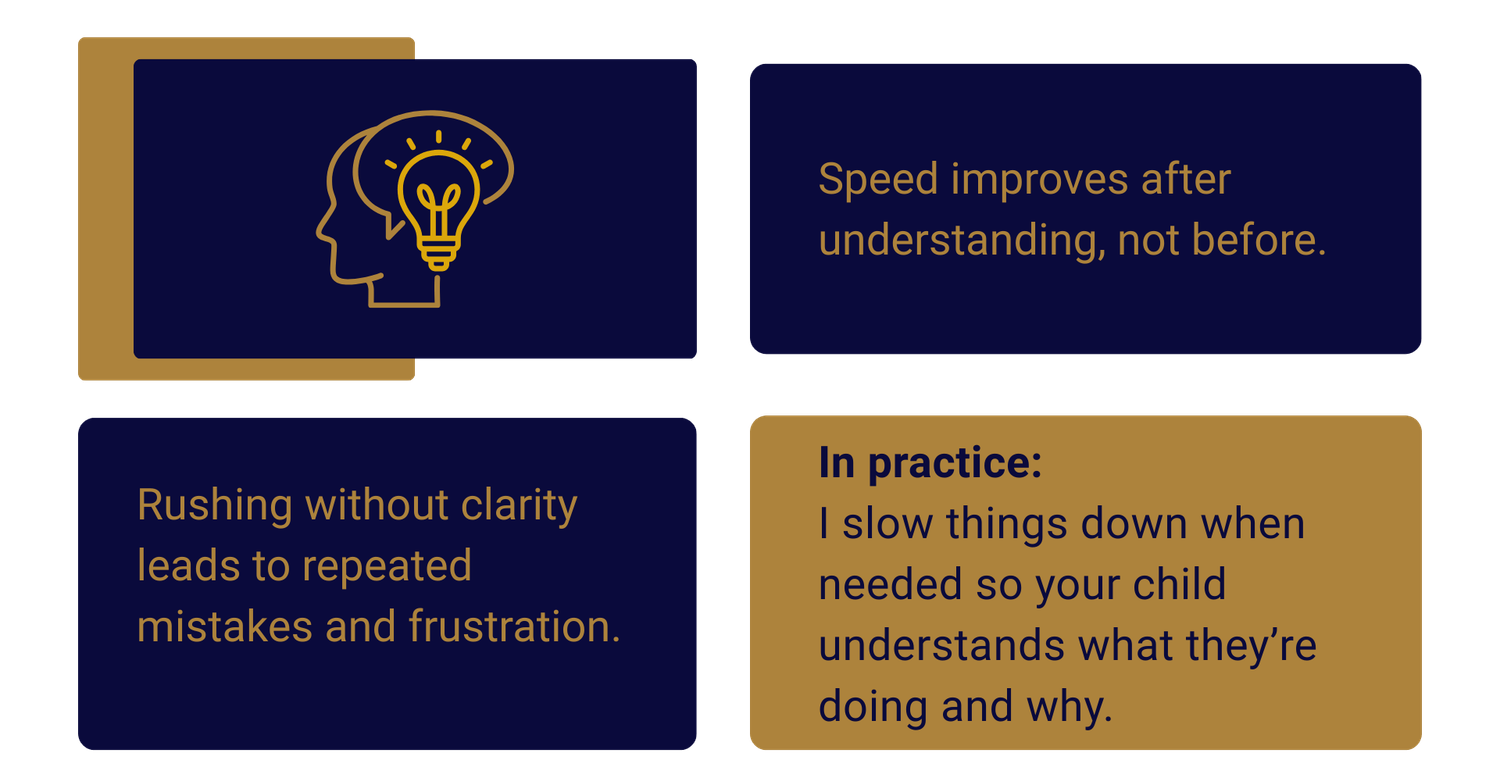
Rushing before understanding is in place leads to repeated errors and frustration, not progress. Slowing down to build real understanding is what makes speed possible later.
Understanding grows when a child thinks about their own thinking.
Metacognition is the ability to notice what you're doing as you learn, recognize what's working, and adjust when something isn't. Research consistently identifies it as one of the strongest predictors of long-term academic growth.
Most instruction doesn't build this directly. A child who completes an assignment correctly may have no idea what they did that made it work. A child who gets something wrong may not know where the understanding broke down.
Every session here includes a moment where your child names what helped, what felt clear, and what they'd do differently. That reflection isn't an add-on. It's the part that makes the skill transferable beyond the session.
How your child feels during learning shapes how well learning works.
When a child feels safe and supported, learning opens up. When a child feels rushed, judged, or uncertain about whether they're capable, the brain's resources go toward managing that experience rather than building new understanding.
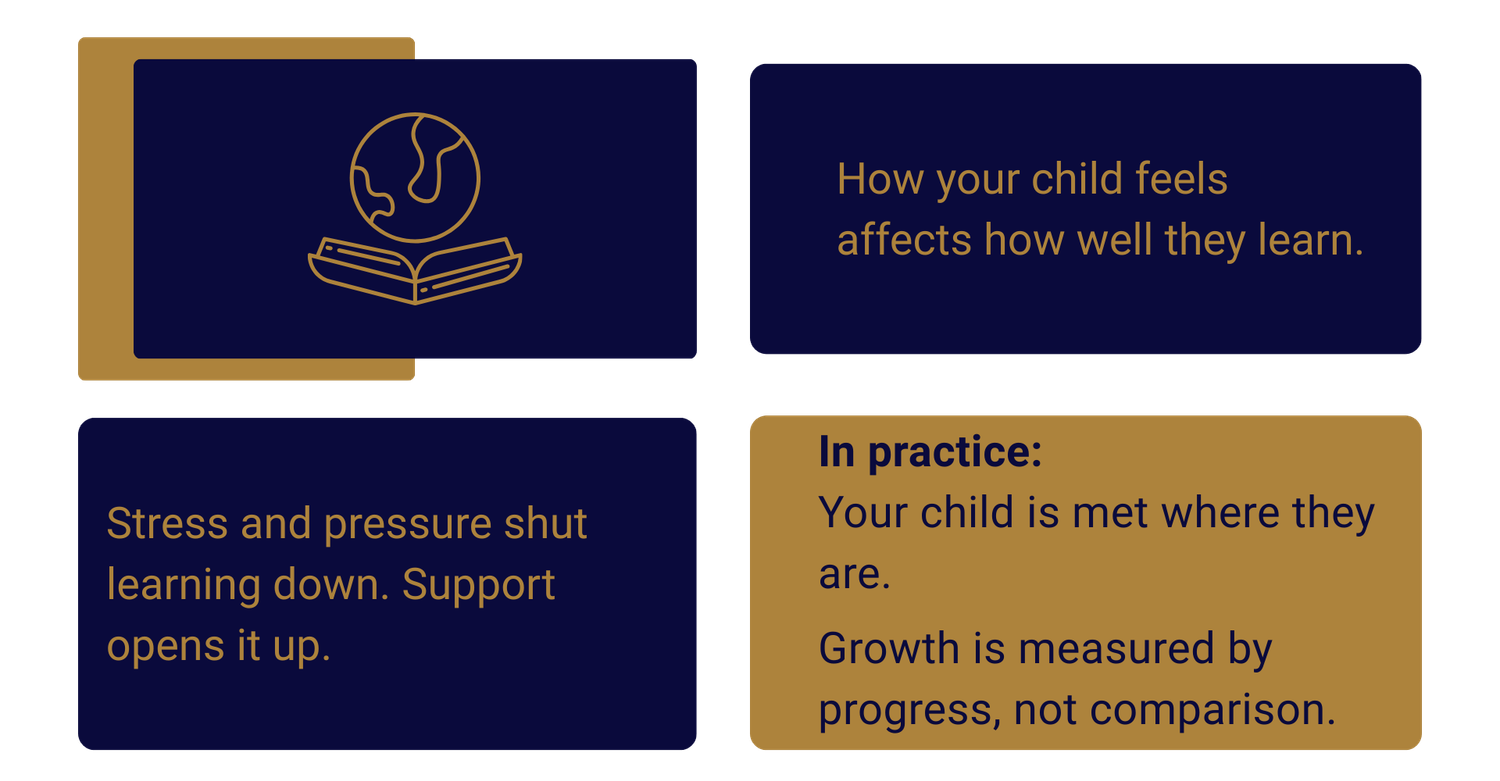
This isn't about avoiding challenge. Challenge is essential. It's about the difference between a challenge that stretches your child and pressure that closes them down.
Every session here meets your child where they are. Growth is measured by progress, not comparison.
Depending on what your child is working on, sessions draw on some or all of three connected areas.
Brain science describes how learning works in general. What it doesn't do is isolate a single process. Reading, writing, and study skills all draw on three connected areas working simultaneously.
Sensory-cognitive processing: building the visualization, phonological, and symbol imagery skills that help your child take in what they read, make sense of it, and use what they see in their mind to get their ideas on paper.
Structured reading, writing, and study systems: teaching your child to read with accuracy, write with clarity, and study with purpose through systems they can use and build on over time.
Metacognitive learning habits: helping your child think about their own thinking, discover what strategies work for them, and develop the awareness to direct their own learning.
No session works on one area in isolation. All three are present in every lesson because that's how the brain actually works.
This approach is grounded in a proprietary instructional framework developed by Learning Re-Engineered.
What does this mean for your child specifically?
Brain science describes how learning works in general. What it doesn't do is tell you what your child needs right now, what's ready to grow, and where instruction should begin.
That's what the Learning Strategy Session is for. It's a complimentary 15-minute conversation where we talk through what you're noticing, how your child currently approaches reading and writing, and what the most useful next steps might be.
No pressure. No commitment. Just a real look at where your child is and what's possible from here.
Your child has the capacity to grow. I believe that before I know anything else about them.
Stay connected with Learning Re-Engineered.
Practical insights on brain-based learning, delivered to your inbox. You'll receive updates, learning strategies, and snippets from the newsletter and blog.

Learning Re-Engineered is led by Alitalia, a brain-based learning strategist helping students gain confidence and clarity in reading, writing, and learning. Through personalized tutoring and immersive learning environments, every pathway is designed around how the brain actually learns.
LEARNING PATHWAYS
Not sure where to start?
EDUCATION FUNDING OPTIONS BY STATE
© 2026 Learning Re-Engineered | All Rights Reserved